
Sound insulation testing at EMPA
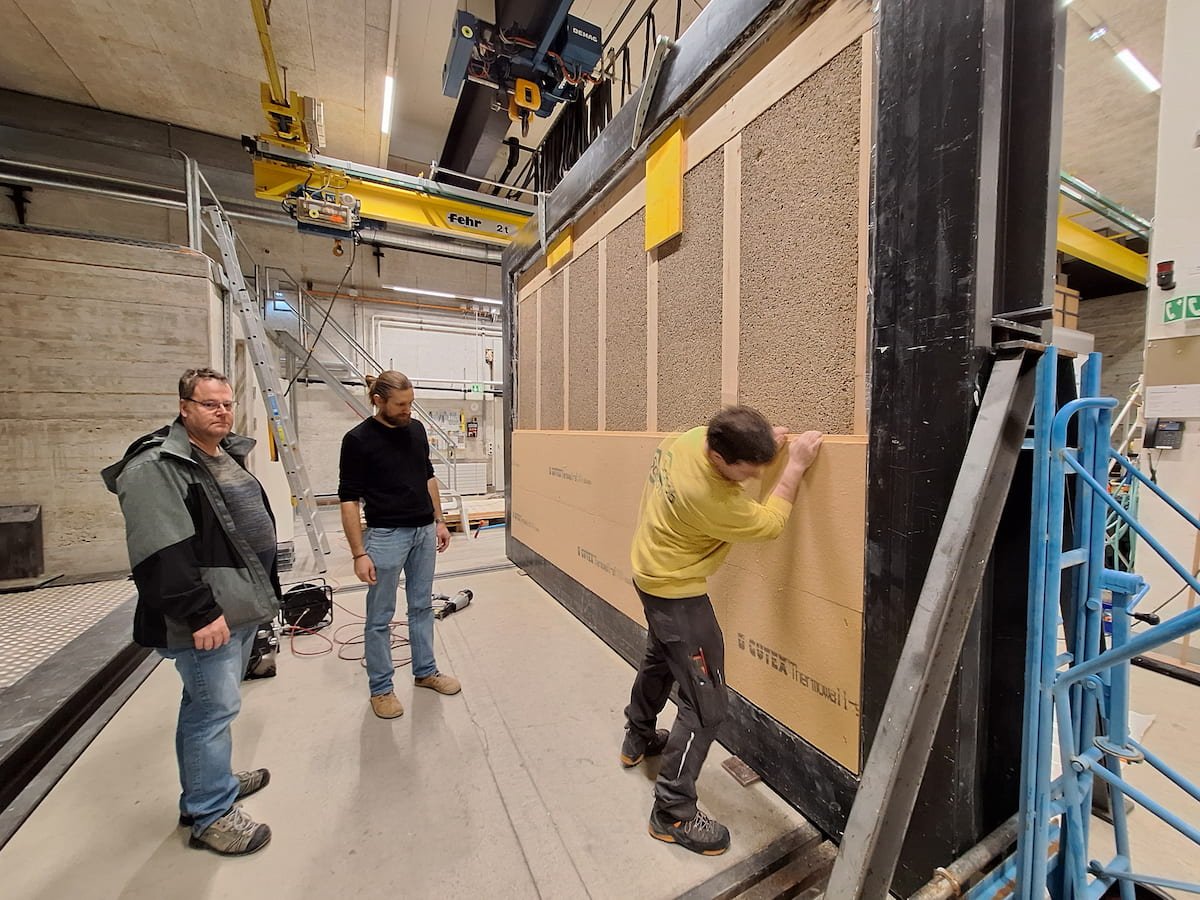
In the EMPA laboratory: The Cancret hemp concrete exterior wall
A milestone for Cancret Materials
At the end of February, Cancret Materials reached an important milestone: our hempcrete exterior wall is currently undergoing sound insulation testing at the specialized laboratory of the Swiss Federal Laboratories for Materials Science and Technology (EMPA). Sound insulation poses a major challenge for all building materials—especially for sustainable materials such as our hempcrete exterior wall.
We are bringing an innovative, 100% C2C-compatible exterior wall system into a testing environment that has previously been dominated by conventional building materials. Installation is complete, measurements are underway, and we expect the exact results later this month. Our goal is clear: to prove that our Cancret exterior wall meets the high requirements for sound insulation—and that with a wall thickness comparable to that of a solid construction.
Why this wall sets new standards
For planners, this means more than just a new product: they get a component that "breathes," promotes a healthy indoor climate, and at the same time embodies sustainability. From our own experience, we know how important it is that sustainable building solutions not only enable a healthy living environment and are environmentally friendly, but also have to be technically and economically convincing. This is precisely the standard we consistently pursue with Cancret.
Our exterior wall made of hemp concrete combines ecological, technical, and economic advantages:
100% renewable building materials – from the core to the surface
monolithic architectural aesthetics - homogeneous materiality of the building materials
Sound insulation – for increased requirements
Diffusion-open – the wall "breathes" and ensures a healthy indoor climate
Wall thickness comparable to solid construction – without compromising on structural integrity or comfort
Cost-neutral – sustainable construction without additional costs
CO₂ negative – and certifiable
Collaboration that enables innovation
Our system is being developed in close cooperation with Schöb AG, Gutex, and RÖFIX AG. Together, we are bringing biogenic building materials into industrial reality—with the aim of achieving Lignum standard structures and component approvals.
Feedback from the industry
Initial feedback from the construction industry clearly shows that there is a great need for recyclable, renewable building components —and many companies are looking for partners to develop new solutions together. At the same time, it is becoming clear that more and more building owners want, need, and are able to build sustainably or even circularly. Price neutrality is an important lever in this regard, but it is no longer the only argument. Reputation, CO₂ budget, reuse, and knowledge advantage are rapidly gaining in importance.